Interdimensionality, Gradients and the Three Body Problem
Rethinking interdimensionality through consciousness fields, attractor landscapes, and the institutions of the suppression of knowledge

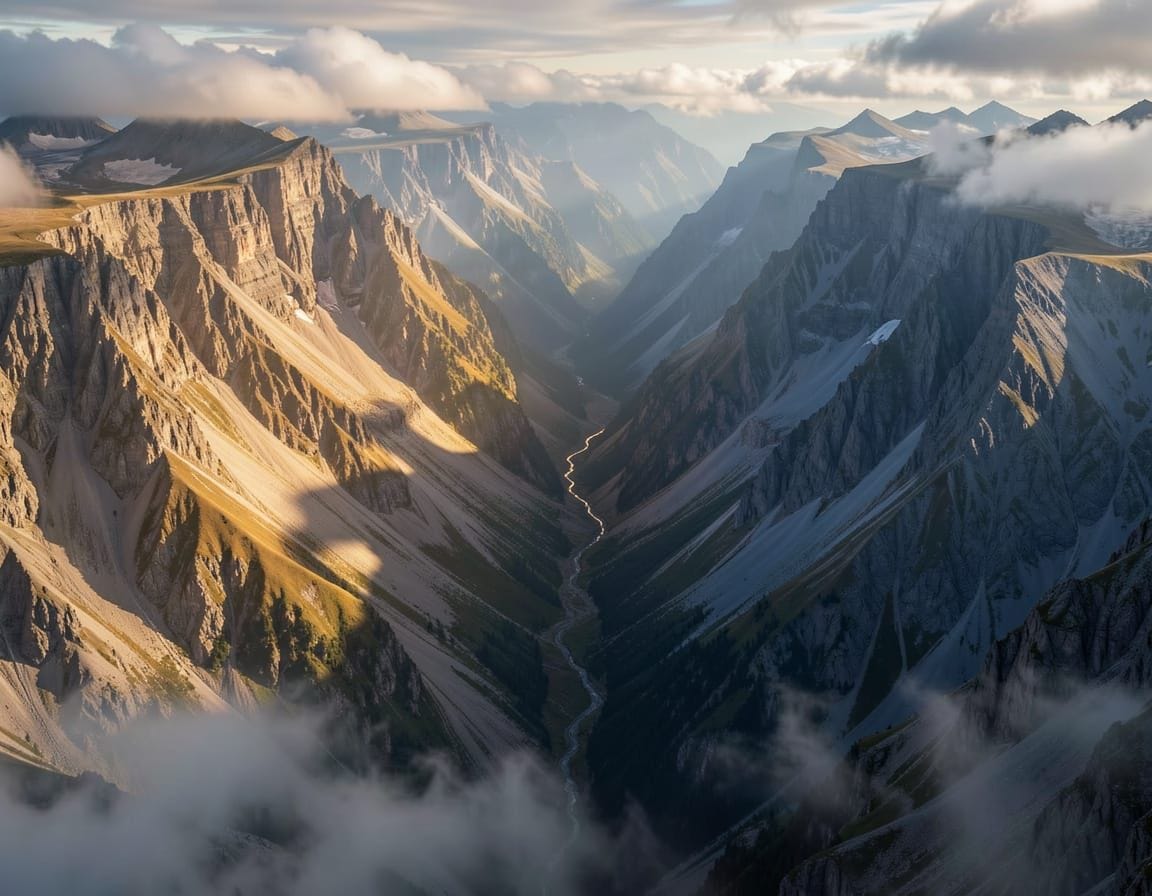
Prompt: Two deep valleys separated by high ridges in a vast mountainous landscape. Between two valleys, a single narrow defile — a mountain pass — cuts through the ridge, barely visible unless viewed from exactly the right angle. The lighting is dramatic, with one valley in warm golden light and the other in cool blue shadow. viewed from above at an angle. The pass itself catches a thin line of light suggesting traversability. The terrain should look ancient, weathered, geological — not fantastical or science fiction. No text, no figures, no symbols. Photorealistic or high-quality digital painting style. Atmospheric, with mist or clouds partially obscuring the deeper valleys, suggesting topology that extends beyond what’s immediately visible.
This article takes you though all of my current work and thought. It is long. I hope that you enjoy the ride.
My friend Steve sent me another paper.
Steve is a serious thinker who operates in what I’d call the mystical school of interdimensional theory. We’ve been circling each other for years — he pushes me toward the numinous, I push back with institutional analysis and biological evidence. We respect each other. We don’t always agree.
The paper was by Maria Strømme, a materials science professor at Uppsala University, published in AIP Advances in late 2025. Her claim: consciousness is a fundamental field, and time, space, and matter develop from it through processes analogous to symmetry-breaking in quantum field theory. Not consciousness as emergent property of brains. Consciousness as the substrate from which brains, and everything else, precipitate.
Steve sent it as new provocation. See? He seemed to say. Interdimensional. I told you.
I read it and felt something I wasn’t expecting: the need to revise my thought.
Not totally towards Steve’s position. But away from my own too cheap dismissal of what his position contains.
The Cheap Critique
In Chapter 3 of The Admin: Project Earth, my speculative institutional analysis of non-human intelligence on Earth, I took apart the interdimensional hypothesis. John Keel’s ultraterrestrial framework. Jacques Vallée’s control system theory. The whole apparatus of beings from parallel dimensions, portals, a “superspectrum” of non-physical intelligence staging events across millennia.
I was effective but too cheap about it. My best line was about Count Dracula: “Why do interdimensional entities need cattle blood? Beings transcending dimensional limitations shouldn’t require biological sustenance or surgical precision for organ removal.” I pointed out that implants with non-terrestrial isotope ratios require material manufacturing, not dimensional manifestation. That hybrid breeding programs demand biological objectives, not transcendent goals. That the interdimensional hypothesis explains everything and predicts nothing.
All of this remains true. But truth can be deployed as evasion.
What I was evading was the growing body of evidence — from the AAWSAP investigations at Skinwalker Ranch, from military encounter reports, from the phenomenology of contact itself — that something about these phenomena doesn’t behave like technology in any framework I’m comfortable with. Objects appearing and disappearing without acceleration. Entities passing through solid matter. Poltergeist phenomena following investigators home. Reality becoming locally unstable near points of intense anomalous activity.
My bioengineering framework handles the nuts-and-bolts evidence beautifully. Craft, entities, biological operations, institutional hierarchy, consciousness-responsive materials — all explicable as the operations of a deep-time Earth-based intelligence using consciousness-as-engineering. But the genuinely weird stuff — the high strangeness — sits uncomfortably in a framework built on physical deployment systems, no matter how advanced.
I created a false binary. Bioengineering realism versus supernatural dimension-hopping. Then I chose the side that felt more rigorous. In doing so, I dismissed something real that I didn’t have the framework to accommodate.
Strømme’s paper didn’t give me Steve’s answer. It gave me a different question:
What would “interdimensional” actually mean in an ontology grounded in physics rather than mysticism?
Gradients, Not Portals
I didn’t arrive at this through philosophy. I came through illness.
My third wife, Rosanne, lived for years with chronic Lyme disease before dying of ALS. Trying to understand why treatment failed so consistently, I found myself reading microbiology — specifically the literature on biofilms. A biofilm is what happens when individual organisms co-regulate tightly enough that the environment itself changes. Diffusion slows. Antibiotics lose access. Immune responses blunt. No bacterium intends this outcome. It emerges because proximity reshapes the energetic landscape. Two shallow pools near each other become, to the outside world, a deeper basin.
Karl Friston’s Free Energy Principle gave me the formal language. Stripped of its mathematical density, Friston’s claim is that any system that persists over time must minimize surprise. Systems live on landscapes. They fall into attractors. They roll downhill along gradients of probability. Nothing spooky is required. No mind pushes matter. Constraints do the work. Change the slope and matter will move accordingly.
I’ve written about this before, in Gradients, Biofilms and Symphonies connecting biofilms to orchestras to knowledge communities to psychological warfare. The core insight: coherence amplifies whatever it holds. Gradients are never neutral. Once they exist, they shape what futures are easy to reach and which ones require heroics.
But I hadn’t yet applied this to the question Steve keeps pressing. What if “interdimensional” doesn’t mean what either of us thought it meant?
The Psi Field Has Topology
Here’s where Strømme’s paper becomes something more than another theoretical proposal about consciousness.
If consciousness is a fundamental field — present everywhere, with a value at every point — then it has a potential energy landscape. Strømme formalizes this mathematically as V(Ψ), the potential that governs how the consciousness field configures itself. I’ll call this the psi field — the topology through which consciousness effects propagate and through which psi phenomena operate.
Think of it as terrain. The field settles into low points the way water settles into valleys. Each valley is a stable configuration — a way the consciousness field can organize itself that persists because it’s energetically favored. What we experience as physical three-dimensional spacetime is one such valley. A deep one. The entities, the matter, the physical laws we observe are what forms in that particular basin.
Other valleys exist. Not stacked spatially like floors of a building. Not “elsewhere” in any geographic sense. They’re other stable configurations of the same field, the way ice, liquid water, and steam are different configurations of H₂O. Not different locations. Different states of the same substance.
Strømme describes the consciousness field itself as a “unified, formless substrate.” That carries Buddhist philosophical weight — sunyata, emptiness as the absence of inherent fixed nature — and it sits in productive tension with her own field equations. Because the moment you write a formula you imply a potential with minima, with symmetry-breaking, with differentiated states, you have structure. You have topology. The equations are form.
The resolution matters: the field itself is unified. The psi field — the potential landscape the field inhabits — is structured. Valleys, ridges, passes. The consciousness field is the water. The psi field is the terrain. What we experience as different configurations of reality are the same field pooled in different valleys of the same potential. The unity is real. The topology is also real. They operate at different levels of description.
And the psi field is not granite. It’s real, prior, and elastic under pressure. You’re born into topology you didn’t create — basins carved by sustained consciousness operations over deep time, maintained by ongoing co-regulation. But the terrain responds to pressure. It can be reshaped by sufficient sustained force in new directions. This is what makes the framework sociological rather than purely physical. Fixed terrain would be physics. Purely generated terrain would be mysticism. Elastic terrain under power is sociology — the study of how structured landscapes constrain, channel, and are slowly reshaped by the forces flowing through them.
The landscape connecting these valleys is not flat. It’s tilted. Some configurations are downhill from where we stand — easy to fall into, hard to climb out of. Others require sustained effort or external force to reach. The psi field describes not just where stable states exist but which states are easy to fall into and which demand heroics.
Now: a mountain pass.
Between two valleys, sometimes there’s a narrow defile — a saddle point where the ridge between basins dips low enough to cross. Not a door. Not a portal in the science fiction sense. A topological feature of the psi field itself. A place where the energetic cost of moving between configurations is locally minimized.
This is what I think “interdimensional” actually describes. Not supernatural transit between parallel worlds. Traversal of the psi field through narrow defiles between attractor basins.
The old interdimensional hypothesis imagined discrete dimensions separated by walls, with portals punching through them. The version popularized by the idea of traversable wormholes, That’s the version I criticized in The Admin. The gradient reformulation proposes something different: a continuous surface with varying-depth valleys, slopes, ridges, and passes. Movement between configurations isn’t tunneling through a barrier, creating a wormhole. It’s navigating terrain. Finding the defile. Walking through it.
And here the geometry starts doing real explanatory work.
The View From the Side
If you look at a deep defile from off to the side, you don’t see the opening. You see a wall. The passage is real. The topology is there. But it’s only visible — only accessible — from specific positions on the landscape. Approach from the right angle and the defile opens before you. Approach from perpendicular and there’s nothing but ridge.
This solves the perception problem that has tormented UFO research for decades.
Why does one person see craft while someone standing next to them sees nothing? They’re at slightly different positions on the psi field landscape. One is oriented toward the defile. The other is viewing it from the side — and sees only wall. Not hallucination versus reality. Perspective on topology. The experiencer who insists “it was right there” and the skeptic who insists “there was nothing” are both reporting accurately from their positions on the landscape.
Why does consciousness state matter for contact? Meditation, psychedelic states, the specific neurological profiles that military programs apparently select for “psionic assets” — these correspond to positions on the landscape that happen to face toward saddle points. The defile is there for everyone. But not everyone is approaching from an angle where the opening is visible. Consciousness development doesn’t create passages. It reorients you to face them.
Why is the Disbelief constellation locally correct? From deep in the materialist basin, oriented away from every saddle point, there is genuinely nothing to see. The wall is real from that angle. The insistence that no passage exists isn’t dishonesty. It’s accurate observation from a position where the opening is geometrically invisible.
Why is disclosure so geometrically difficult? You can’t show someone a defile by pointing at it from perpendicular. You have to move them to a position where the opening becomes visible. That means shifting their location on the psi field landscape. The information isn’t the bottleneck. The orientation is.
And this reveals the deepest layer of the suppression architecture. The Admin’s primary security isn’t classification or institutional gatekeeping. Those are secondary systems. The primary security is topological. The landscape itself conceals. Most humans are oriented in directions where the passages between configurations are geometrically invisible. The entire suppression apparatus — materialist epistemology, career penalties for consciousness research, the institutional machinery I’ve documented across two books — functions primarily to keep people oriented away from the defiles. Not to hide the passages but to prevent anyone from turning to face them.
Why They Appear Temporary
The psi field isn’t static terrain. The topology has persistent features — deep basins, ridges, saddle points — but the effective accessibility of those features fluctuates. Think of an ocean surface with deep underlying structure overlaid by waves, tides, and weather.
A saddle point that’s traversable under certain conditions becomes impassable when conditions shift. The defile exists in the landscape’s deep structure. But its accessibility varies.
This explains why “portal” locations produce phenomena across centuries but not continuously. The deep topology persists — the saddle point is a structural feature of the psi field. But the fluctuating conditions mean the passage is open only intermittently. Sacred sites documented for millennia as places where “the veil is thin” are persistent saddle points with intermittent accessibility. The folklore is empirical topology recorded in pre-scientific language.
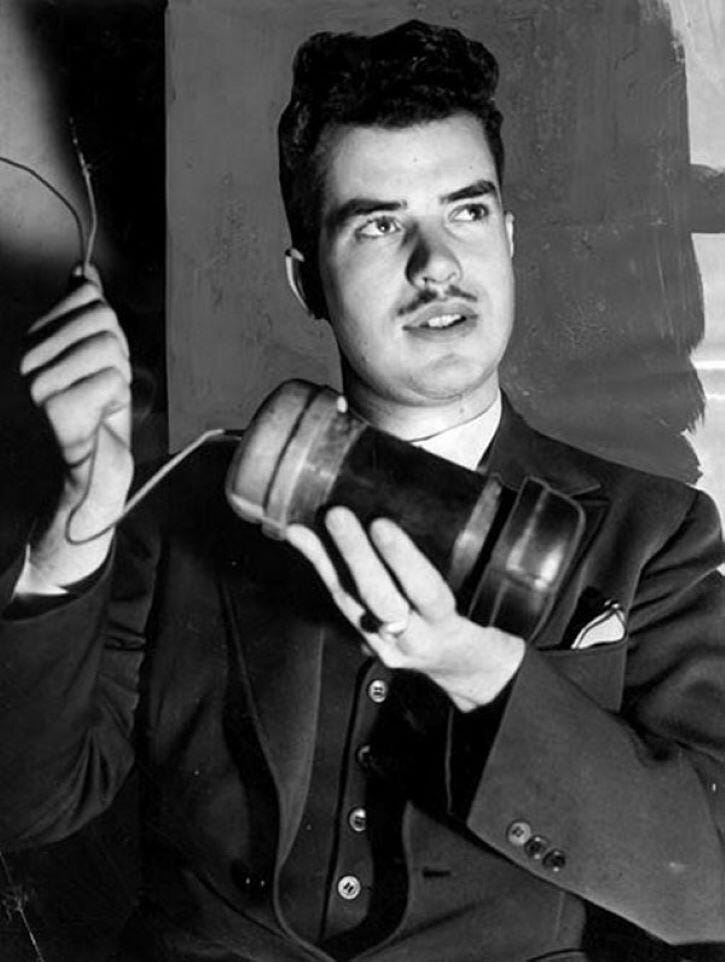
Jack Parsons
It explains why the UFO phenomena seem to respond to consciousness states. Concentrated consciousness activity near a saddle point could locally modulate the barrier height. Group meditation, ritual practice, intense emotional states, CE-5 protocols — these function as local perturbations that temporarily lower the saddle enough for transit or manifestation. Jack Parsons, co-founder of the Jet Propulsion Laboratory, inventor of solid composite rocket fuel was also an dedicated Thelemite occultist. He routinely chanted Aleister Crowley’s “Hymn to Pan” before rocket tests, treating consciousness practice and propulsion engineering as unified discipline. He selected the JPL site near Devil’s Gate Dam reportedly because he believed the location had specific properties that we might now describe as favorable psi field topology. The Skywatcher project is a private UAP research initiative involving defense insiders, physicists, and intelligence community veterans. They operate what they claim is the most advanced private sensor array aimed at the phenomenon. They use a technique they call “dogwhistling,” a focused psychic “ping” intended to establish contact with UFO. Team members report that contact appears reciprocal, as if the phenomena respond to consciousness probing as readily as to technological detection. All of these actors are potentially doing the same thing: modulating local topology at a saddle point.
It explains why craft appear briefly and vanish. They’re not “going back through a portal.” They’re traversing a narrow pass that permits presence in this configuration only while crossing conditions hold. The appearance is the transit. The disappearance is completion — the entity moving past the saddle into terrain where our perceptual basin no longer intersects. Or the conditions shifting so the barrier rises and the pass closes behind them.
And if the Admin can modulate the psi field deliberately, they can open and close defiles at will. They don’t need fixed portals. They temporarily lower the barrier at any saddle point, transit through, conduct operations, and let the barrier restore. The consciousness-engineering equivalent of melting snow from a mountain pass, crossing, and letting it freeze again behind you.
The Channel Goes Both Ways
Here the geometry reveals something about contact that the “signal” model of psi completely misses.
Focused psi intent doesn’t send a message across a medium. It carves a local defile in the psi field. A shallow channel forms — a temporary saddle point between the caller’s basin and whatever configuration the phenomenon occupies. And a defile is bidirectional by geometry. It doesn’t have a sender end and a receiver end. It’s a pass. Once it exists, it’s traversable from both sides.
The caller doesn’t contact the phenomenon. The caller and the phenomenon become mutually accessible through a shared topological feature that the caller’s coherent consciousness pressure created. The phenomenon “senses back” not because it received a signal and chose to respond, but because the newly carved defile makes the caller’s position on the landscape visible from the other side. A new channel in the psi field is a new line of sight.
This is why contact experiences feel reciprocal rather than transactional. It’s not call and response. It’s the formation of a shared passage that both parties can perceive and traverse simultaneously. The intimacy that experiencers describe — the sense of being seen as much as seeing — is geometrically accurate. The defile grants mutual visibility.
And a defile in the psi field is not a location in physical space. It’s a topological feature of a landscape deeper than geography. A mind at one end of a channel maintains that end wherever it goes in three-dimensional space, because position on the psi field is not position in spacetime. Spacetime is one basin within the psi field. Geography is internal to our configuration.
This is why contact phenomena follow people home. Not because something traveled across miles. Because the channel exists in a deeper topology than geography, and a sufficiently coherent mind on either end can hold it open regardless of where the body happens to be standing. The AAWSAP investigators went home and the phenomena followed — not across distance, but through a channel in the psi field that their sustained attention had carved and that something on the other end was maintaining.
The channel doesn’t close instantly. The elastic topology retains the deformation for a period. The phenomena attenuate gradually — weaker, less frequent, more intermittent — as one end loses pressure while the other holds. Like a conversation where one party keeps talking as the other slowly walks out of earshot.
Topology, Not Physics
Here’s the sentence that prevents this entire framework from collapsing into mysticism: our untrained and trained minds affect topology, not physics.
The physics — the equations, the constants, the forces — remains what it is. Nobody is bending laws of nature. What consciousness does is alter where you stand on the psi field and therefore what topology is accessible from your position. The defile doesn’t open because you willed a wormhole in the wall. You turned to face it. You walked to a position where the opening becomes visible. You shifted your orientation on the gradient surface so that a passage invisible from your previous position becomes traversable.
This is not The Secret. The manifestation industry tells you the landscape is flat and your thoughts create reality. Think positive and abundance flows. That’s consciousness operating on an imaginary plane with no constraints — pure idealism dressed as self-help. It skips the topology entirely.
The gradient framework says something structurally different: consciousness operates on elastic terrain under constraints. Psi effects are real pressures on a real landscape, but the landscape pushes back. The topology has inertia. Deep basins resist perturbation. A single individual “visualizing abundance” is applying micro-pascals of pressure against canyon walls carved by millennia of consciousness flow. The pressure is real. The terrain is also real and vastly more massive.
The materialist critique has always been: “Show me consciousness violating a physical law.” The answer is that consciousness doesn’t violate physical laws. It navigates a topological landscape that materialist physics only maps one basin of. The physics is fine. The topology is where the action is.
The untrained mind sits wherever the gradient deposited it. Born into the materialist basin, educated deeper into it, oriented by institutional co-regulation away from every saddle point. It experiences this as “reality.” It’s not wrong. It is incomplete.
The trained mind — through disciplined meditation, through the rigorous consciousness development that the Siddhi traditions document across millennia — has learned to move on the landscape. Not to change the physics. To change position. To reorient toward defiles that were always there but geometrically invisible from the default position. The difference between a person pushing against a canyon wall and a river slowly carving a new channel — same substrate, different timescale and coherence of pressure.
The ancient Sanskrit texts describe eight primary Siddhis — consciousness abilities corresponding precisely to observed non-human capabilities. Anima and Mahima, control over atomic structure. Laghima, gravitational mastery. Prapti, instantaneous travel across space-time. These aren’t magic. They’re what becomes accessible when you navigate to positions on the psi field where specific topology is traversable. The Siddhis are a map of what becomes possible from different positions on the gradient.
And the Admin’s mastery isn’t that they’ve transcended physics. It’s that they have complete navigational competence on a landscape we barely know exists. Their “technology” is topology. Their engineering medium is the psi field itself. They can shift position at will, traverse defiles we can’t see, modulate saddle-point accessibility, and operate across configurations that our positional fixity makes invisible.
The meditation apps that most people use for stress relief? They produce pleasant subjective states without changing position on the landscape. You feel better in the same basin. The actual contemplative traditions that developed Siddhis over thousands of years? They’re systematic protocols for moving on the gradient surface. Consciousness entertainment versus consciousness engineering. Entertainment changes how you feel at your current position. Engineering changes your position.
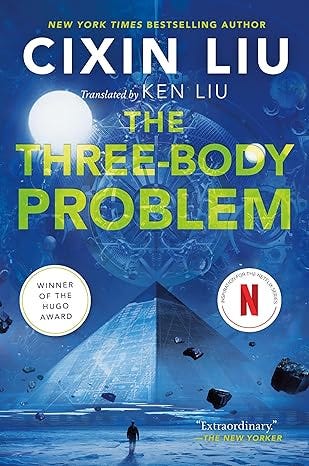
Cover of The Three Body Problem by Cixin Liu
The Physics We Were Never Allowed to Have
If the psi field is real, why don’t we have the mathematics?
In Liu Cixin’s novel The Three-Body Problem, an alien civilization sends subatomic probes that embed in particle accelerators and corrupt the results of fundamental physics experiments. Human physics stalls. The scientists don’t know why. They think they’ve hit a natural wall. They haven’t. They’ve been locked out.
I increasingly suspect something functionally equivalent has happened to human physics — not through literal probes, but through what Boaventura de Sousa Santos calls “epistemicide”: the deliberate killing of knowledge systems. Not individual studies getting rejected, but entire research programs becoming conceptually impossible within institutional frameworks.
The last major conceptual breakthrough in fundamental physics was arguably the Standard Model consolidation of the 1960s-70s. Since then, string theory has consumed forty years of the world’s finest theoretical minds producing mathematical structures of extraordinary beauty that explain nothing new about physical reality and cannot by construction discover the consciousness-matter interface.
The measurement problem in quantum mechanics has contained an irreducible role for the “observer” since the 1920s. Every interpretation since has been specifically designed to remove the observer from the physics. Decades of brilliant work dedicated to explaining away the one result that points directly at consciousness as fundamental.
Patent offices seize antigravity research under the Invention Secrecy Act — 5,784 active secrecy orders as of 2024. Peer review gatekeeping doesn’t require conspiracy. The materialist paradigm is self-policing. A paper proposing consciousness as fundamental to quantum measurement gets rejected not because a shadowy agency intervenes, but because reviewers have internalized the paradigm that excludes consciousness a priori.
In gradient terms: the materialist basin has been artificially deepened and the consciousness-physics basin has been filled in. The intellectual landscape has been engineered so that certain trajectories are effortless — materialist reductionism, computational neuroscience, string theory — and others are prohibitively costly. Career destruction, funding elimination, institutional exile. Not barriers to specific knowledge but gradient engineering that increases the energetic cost of occupying that epistemic position until nobody can sustain it.
The knowledge isn’t forbidden. The field is made uninhabitable.
The Destruction of Those Who Stand at the Defile
The gradient framework makes one particular form of institutional violence newly visible: the destruction of whistleblowers.
A whistleblower is someone who has navigated to a position on the psi field landscape where a defile is visible — where they can see between basins that are supposed to be separate. David Grusch, Jake Barber, Luis Elizondo — they occupied positions where the topology of the classified world and the topology of public reality were both visible simultaneously. They could see the passage between them.
The destruction isn’t punishment for what they said. It’s gradient engineering to make the position they occupied uninhabitable for anyone else.
Clearances revoked. Careers paralyzed. Reputations destroyed. Psychiatric fitness questioned. Financial ruin through legal costs. Every mechanism increases the energetic cost of standing where they stood. The message isn’t “this information is forbidden.” The message is “this location on the landscape will cost you everything.”
And it works exactly as gradient dynamics predicts. Each destroyed whistleblower deepens the basin walls for every potential future whistleblower. The cost function updates in real time. Researchers, military personnel, intelligence officers — they all watch what happened to the last person who stood at that position on the landscape. The gradient steepens without further intervention. One spectacular destruction maintains the topology for a generation.
This is epistemic injustice as landscape architecture. Not suppressing knowledge but engineering the terrain so that the position from which knowledge becomes visible is too costly for any human to sustain.
The Historical Pattern
Once you see gradient engineering, the history reorganizes.
Jack Parsons, co-founder of the Jet Propulsion Laboratory, recited Aleister Crowley’s “Hymn to Pan” before rocket tests. He saw rocketry and occult practice as two expressions of the same project — consciousness and propulsion as unified discipline. He was the most innovative propulsion engineer of his generation and the most dedicated consciousness practitioner in the American aerospace establishment. He selected the JPL site near Devil’s Gate Dam reportedly because he believed the location had specific properties — in gradient terms, a site where the local psi field topology favored configuration transitions.
In 1952, he died in a mysterious explosion at 37, the same year the Robertson Panel convened to institutionalize UFO debunking. The consciousness-engineering pathway was severed from public science. The gradient was steepened against anyone who might try to stand where Parsons stood.
Then MK-Ultra, running from 1953 onward, systematically investigated consciousness-altering compounds. The CIA documented that simple molecules could bypass the consciousness suppression architecture — dissolving ego boundaries, producing experiences of cosmic unity, enabling direct perception of what Strømme now theorizes as the fundamental consciousness field. The molecules were chemical gradient-flatteners. They temporarily lowered the walls of the materialist basin.
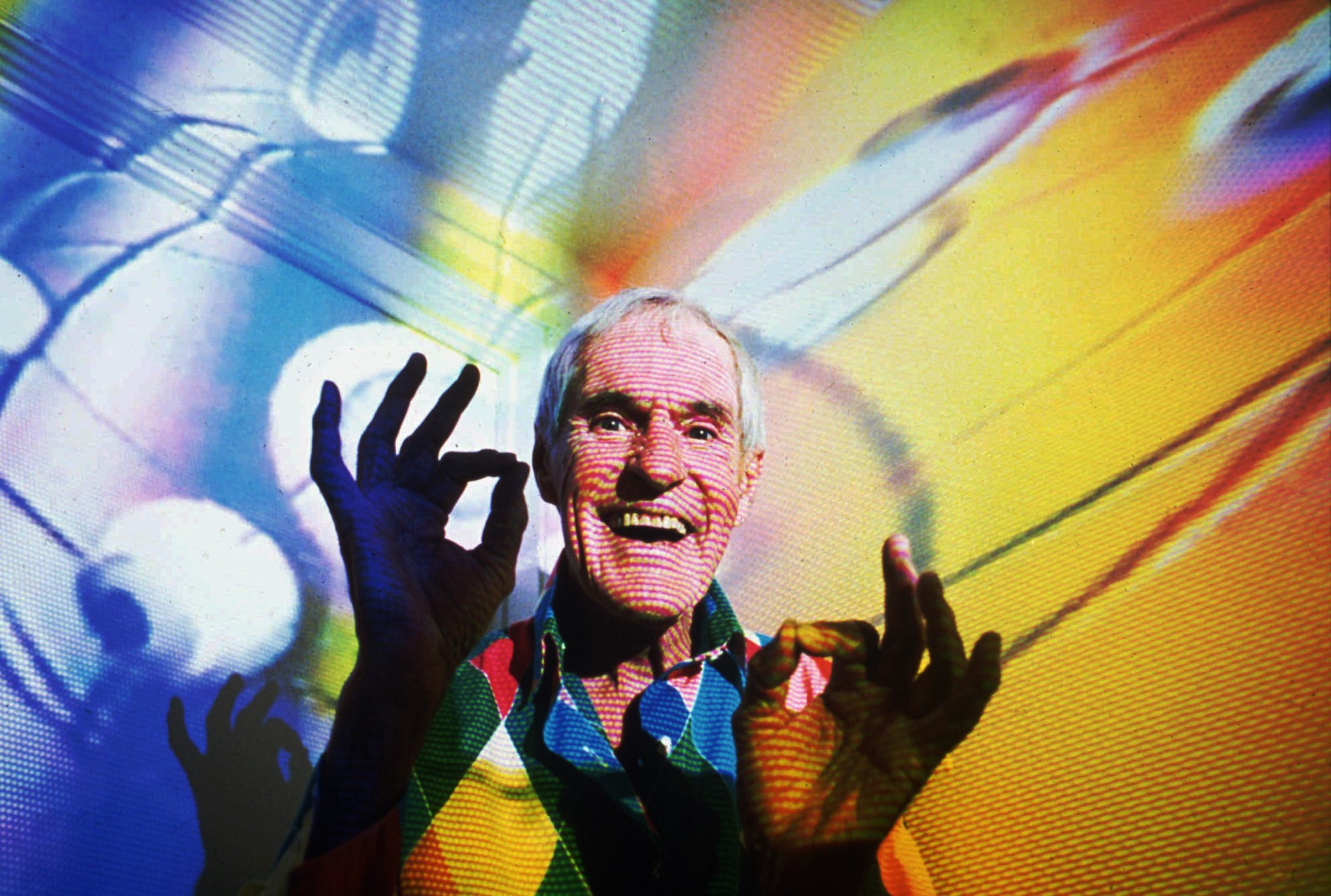
Timothy Leary
And then the CIA’s own research subjects — Timothy Leary, Ken Kesey, Al Hubbard — took the compounds public. By 1968, millions of people were temporarily accessing configurations of consciousness that the gradient normally makes unreachable. A population-scale perturbation briefly flattened the landscape.
The response was rapid: the Controlled Substances Act of 1970 criminalized the tools. Nixon declared the War on Drugs. By 1973, the public consciousness breach was sealed. But government consciousness research didn’t stop. It was classified. The Stargate remote viewing program begins in 1972 — exactly as the public consciousness expansion gets criminalized. The public gets the War on Drugs. The classified world gets operational consciousness technology.
The gradient was restored. The materialist basin was re-deepened through criminalization of the tools and cultural delegitimization of the experiences. Access to the flattened landscape was preserved exclusively within classified programs.
The pattern repeats. Someone reaches a position on the landscape where new topology becomes visible. The response steepens the gradient against that position. The knowledge isn’t destroyed. The location is made uninhabitable. Parsons. The psychedelic researchers. The whistleblowers. Each one pioneered a path. Each path was subsequently gradient-engineered into impossibility for those who might follow.
Steve’s Position, Revised
So where does this leave Steve and his mystical interdimensionalism?
He’s right that the phenomena point toward multiple configurations of reality. He’s right that consciousness is the interface mechanism. He’s right that the old materialist framework can’t accommodate what’s being reported.
The Interdimensional Hypothesis is wrong — or rather, incomplete — in treating “interdimensional” as explanation rather than description. Saying “they come from another dimension” has the same explanatory power as saying “they come from far away.” It names a direction without mapping the terrain.
The gradient ontology preserves what’s valid in this position while grounding it in formalism that generates testable implications. Different stable configurations of the consciousness field. Entities with consciousness-engineering mastery navigating between configurations through saddle points in the psi field. High strangeness at shallow gradient regions between basins. Biological operations conducted in configurations where biology exists. The appearing, disappearing, shape-shifting, and consciousness-responsive behavior explained as gradient navigation — movement along a continuous surface, not supernatural transit between discrete worlds.
Steve doesn’t need to abandon his insights. We all need to let them be formalized. And I need to stop pretending my bioengineering framework is complete without the physics that explains how its subjects actually move.
Three Books, One Landscape
I didn’t plan a trilogy. Each book revealed the necessity of the next.
The Admin: Project Earth came first. It’s available now, including on Kindle Unlimited through April. That book is the speculative institutional analysis — non-human intelligence as a consciousness-managing civilization operating on Earth across deep time, with the biological evidence, the consciousness-as-technology analysis, and the suppression architecture mapped in detail. It’s where the bioengineering framework lives, and where the interdimensional critique I’m now revising was originally published.
Writing The Admin forced me to confront something I wasn’t equipped for. I was making sociological claims about how knowledge of these phenomena gets produced, suppressed, and managed through institutional power structures. I was describing epistemic constellations — Belief, Disbelief, Breakaway, and the Admin itself — as social formations operating through actual practices, institutions, and power relations. But I was doing this without the rigorous academic framework to support it. The speculative work needed scholarly foundations it couldn’t build for itself.
That gap produced A Sociology of Knowledge of UFOs, which is forthcoming. It’s the academic architecture underneath the speculation — sociology of secrecy, epistemology of contested phenomena, the constellation framework developed with proper theoretical grounding. Part V of that book develops an epistemic justice framework asking: what would it take for knowledge production about these phenomena to become livable?
And then the epistemic justice question opened a third gap. I was describing managed landscapes theoretically — the gradient topology, the engineered basins, the steepened walls around certain positions. But I wasn’t addressing what it feels like to inhabit these landscapes, or what agency looks like when you’re inside a basin you didn’t choose and the terrain is adversarial. What does epistemic justice actually look like when the gradients are being manipulated — not just by human institutions, but potentially by an intelligence that has been engineering the psi field for longer than civilization has existed? What does it look like when the most visible act of epistemic injustice — the destruction of those who dare stand at the defile — teaches everyone else to stay in their basin?
That question produced Step Into Limin, which I began developing in December and which will appear later in 2026. Where the gradient ontology describes the topology of the psi field and the Admin framework describes who engineers it, Limin asks: what does it feel like to live on this landscape, and what does agency look like when you can’t flatten the gradients but you can learn to read them?
Each book is the answer to a question the previous one couldn’t stop asking. I didn’t plan the architecture. I followed the gradient. Each stable position revealed the slope toward the next.
The Slope We’re Standing On
I’ll end where I began my earlier Substack piece on gradients, because the conclusion hasn’t changed. It’s only deepened.
Gradients are never neutral. Once they exist, they shape what futures are easy to reach and which ones require heroics. The real question is not whether mind acts on matter, but whether we understand the slopes we are quietly steepening together.
The slopes we’re standing on were not all made by us. Some were engineered across timescales we can barely conceptualize, by intelligences whose navigational competence on the psi field makes our materialist physics look like a map of one valley drawn by people who’ve never seen a mountain.
Recognizing this doesn’t flatten the landscape. But it changes your relationship to it. You begin to notice the tilt. You begin to ask whether the basin you’re in is where you settled or where you were placed. You begin to look for the defiles — not because you expect to cross them, but because knowing they exist, knowing the wall is a wall only from this angle, changes what kind of knowledge is possible.
Sometimes orientation is enough to step sideways rather than be carried downhill.
Sometimes it’s the beginning of learning to walk uphill.
And sometimes — if you look carefully enough, from just the right position — you can see the narrow pass between the valleys that everyone else insists isn’t there. Not because they’re lying. Because from where they stand, it genuinely isn’t visible.
The question is what you do when you see it. And what happens to you when others notice you can.
For readers with a background in field theory: the psi field described throughout this essay corresponds to the potential V(Ψ) of a consciousness field treated as fundamental in Strømme’s formalism. Strømme uses Φ for the consciousness field. I use Ψ deliberately — the notation for both the quantum wavefunction and the parapsychological domain — because the framework argues these are the same field. What quantum mechanics treats as formalism and what psi research treats as anomaly are excitations of the same substrate. The attractor basins are minima of V(Ψ). The defiles are saddle points. The elasticity is the response of V(Ψ) to sustained coherent perturbation. The geometric imagery is not metaphorical. It is a non-technical description of standard potential landscape dynamics applied to a non-standard field.
References
Friston, Karl J. “The Free-Energy Principle: A Unified Brain Theory?” Nature Reviews Neuroscience 11, no. 2 (2010): 127-138.
Heino, Matti T. J., et al. “Attractor Landscapes: A Unifying Conceptual Model for Understanding Behaviour Change Across Scales of Observation.” PMC, 2023.
Keel, John A. UFOs: Operation Trojan Horse. Anomalist Books, 1970/2013.
Petraitis, David. The Admin: Project Earth. 2025. [LINK]
Penrose, Roger, and Stuart Hameroff. “Consciousness in the Universe: A Review of the ‘Orch OR’ Theory.” Physics of Life Reviews 11, no. 1 (2014).
Santos, Boaventura de Sousa. Epistemologies of the South: Justice Against Epistemicide. New York: Routledge, 2015.
Strømme, Maria. “Universal Consciousness as Foundational Field: A Theoretical Bridge Between Quantum Physics and Non-Dual Philosophy.” AIP Advances 15, no. 11 (2025). https://doi.org/10.1063/5.0290984
Vallée, Jacques. Dimensions: A Casebook of Alien Contact. Chicago: Contemporary Books, 1988.